GSTR-3B Due Date for QRMP/Quarterly Filers: Complete 2026 Guide
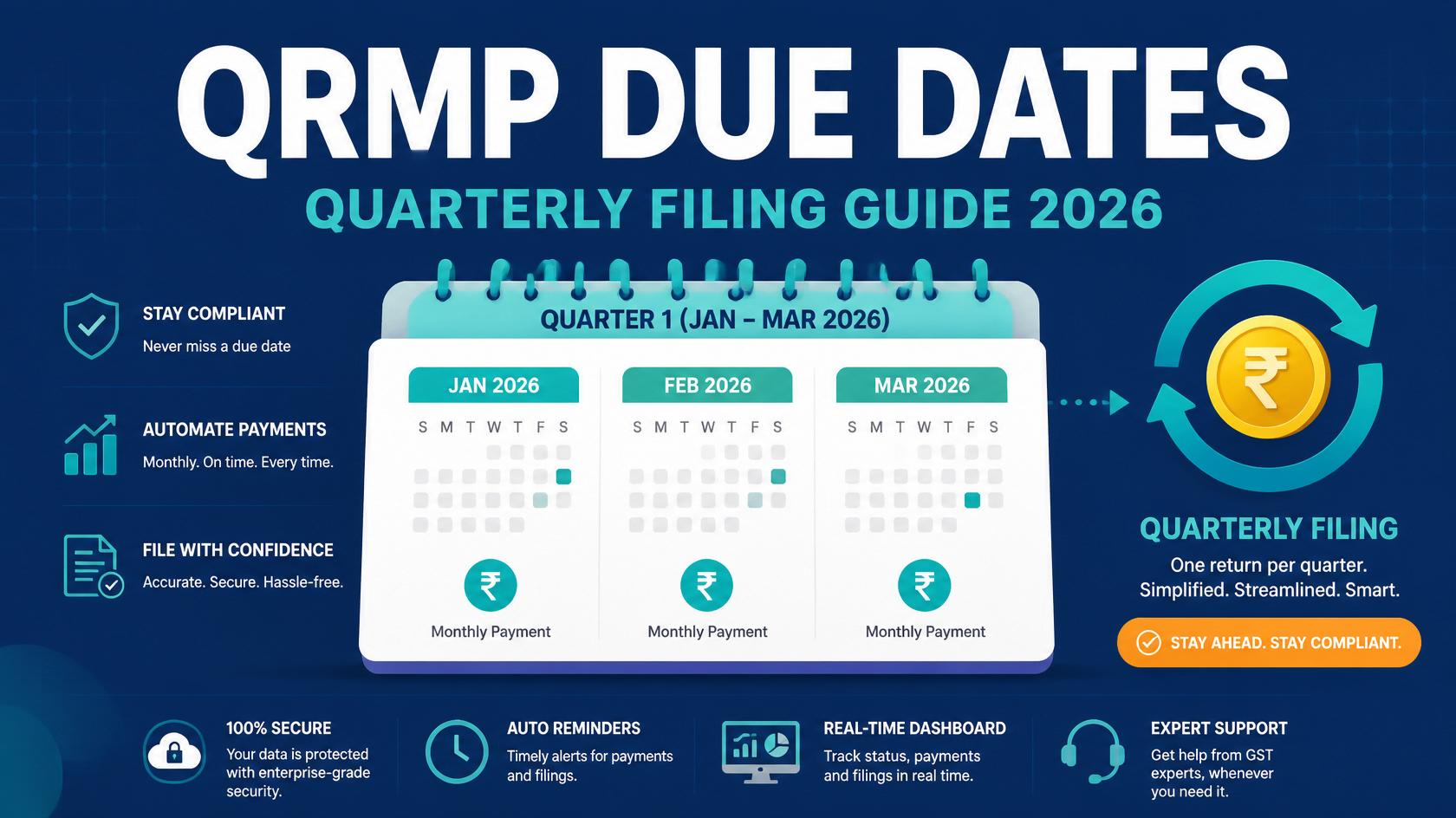
GSTR-3B Due Date for QRMP/Quarterly Filers: Complete Guide
If you're on the QRMP scheme, your GSTR-3B due date isn't a single fixed date — it depends on your state, and it runs alongside a separate monthly payment deadline that catches a lot of businesses off guard. Filing quarterly doesn't mean thinking about GST only once every three months; tax still has to move monthly.
This guide lays out everything QRMP filers need to track — eligibility, exact due dates by state category, monthly payment deadlines, and what happens if you miss one.
What Is the QRMP Scheme?
QRMP stands for Quarterly Return Monthly Payment — a scheme that lets eligible taxpayers file GSTR-3B (and GSTR-1) once every quarter instead of monthly, while still depositing tax every month. It was designed to reduce the filing burden on smaller businesses without disrupting the government's monthly tax collection cycle.
The name itself tells you the structure: quarterly return, monthly payment — two separate cadences running in parallel.
Who Is Eligible for QRMP?
Eligibility Criterion | Requirement |
|---|---|
Aggregate annual turnover | Up to ₹5 crore in the previous financial year |
Return filing status | All pending GSTR-3B returns must be filed before opting in |
GSTIN registration type | Available to regular taxpayers (not applicable to composition scheme taxpayers, who file separately) |
Opt-in frequency | Can be changed at the start of each quarter, within the specified window |
Applicability | Opted at the GSTIN level — each GSTIN under a PAN can independently choose QRMP or monthly filing |
QRMP Opt-In and Opt-Out Window
Quarter | Opt-In/Opt-Out Window Opens | Opt-In/Opt-Out Window Closes |
|---|---|---|
April–June | 1 February | 30 April |
July–September | 1 May | 31 July |
October–December | 1 August | 31 October |
January–March | 1 November | 31 January |
Once the window closes for a quarter, the choice made (or the default carried over from the previous quarter) applies for that entire quarter and cannot be changed mid-quarter.
GSTR-3B Due Dates by State Category
QRMP due dates depend on where your principal place of business is registered. States and union territories are split into two categories, each with a different due date.
Category X States/UTs — Due Date: 22nd of the month after the quarter
Chhattisgarh, Madhya Pradesh, Gujarat, Maharashtra, Karnataka, Goa, Kerala, Tamil Nadu, Telangana, Andhra Pradesh, Daman and Diu, Dadra and Nagar Haveli, Puducherry, Andaman and Nicobar Islands, Lakshadweep
Category Y States/UTs — Due Date: 24th of the month after the quarter
Himachal Pradesh, Punjab, Uttarakhand, Haryana, Rajasthan, Uttar Pradesh, Bihar, Sikkim, Arunachal Pradesh, Nagaland, Manipur, Mizoram, Tripura, Meghalaya, Assam, West Bengal, Jharkhand, Odisha, Delhi, Jammu and Kashmir, Ladakh, Chandigarh
Quarterly GSTR-3B Due Dates for FY 2026–27
Quarter | Period Covered | Category X Due Date | Category Y Due Date |
|---|---|---|---|
Q1 | April–June 2026 | 22 July 2026 | 24 July 2026 |
Q2 | July–September 2026 | 22 October 2026 | 24 October 2026 |
Q3 | October–December 2026 | 22 January 2027 | 24 January 2027 |
Q4 | January–March 2027 | 22 April 2027 | 24 April 2027 |
Monthly Tax Payment Under QRMP (Form PMT-06)
This is the part of QRMP that trips up the most businesses. Even though the return is filed quarterly, tax liability for the first two months of the quarter must still be deposited monthly, using Form PMT-06, by the 25th of the following month. Only the third month's balance is settled when the quarterly GSTR-3B itself is filed.
Month | PMT-06 Due Date | Payment Method Options |
|---|---|---|
1st month of quarter | 25th of the following month | Fixed Sum Method or Self-Assessment Method |
2nd month of quarter | 25th of the following month | Fixed Sum Method or Self-Assessment Method |
3rd month of quarter | Settled via quarterly GSTR-3B filing | N/A — no separate PMT-06 required |
PMT-06 Payment Methods Explained
Method | How It Works | Best Suited For |
|---|---|---|
Fixed Sum Method | Pre-filled challan based on 35% of the previous quarter's tax paid in cash | Businesses with stable, predictable monthly turnover |
Self-Assessment Method | Taxpayer calculates actual tax liability for the month based on real sales and ITC | Businesses with fluctuating monthly turnover, to avoid over- or under-paying |
PMT-06 Due Dates for FY 2026–27
Month | PMT-06 Due Date |
|---|---|
April 2026 | 25 May 2026 |
May 2026 | 25 June 2026 |
July 2026 | 25 August 2026 |
August 2026 | 25 September 2026 |
October 2026 | 25 November 2026 |
November 2026 | 25 December 2026 |
January 2027 | 25 February 2027 |
February 2027 | 25 March 2027 |
Invoice Furnishing Facility (IFF) for QRMP Filers
QRMP filers who want their B2B invoices to reflect in their buyers' GSTR-2B sooner than the quarterly cycle can use the Invoice Furnishing Facility (IFF) to report B2B invoices monthly, for the first two months of the quarter, without affecting their own quarterly GSTR-3B cycle.
IFF Period | Due Date |
|---|---|
1st month of quarter | 13th of the following month |
2nd month of quarter | 13th of the following month |
3rd month of quarter | Reported in the quarterly GSTR-1, not via IFF |
Using IFF is optional, but it matters for your buyers — without it, your B2B invoices from the first two months of the quarter won't appear in their GSTR-2B until your quarterly GSTR-1 is filed, delaying their ITC.
Late Fees and Interest for QRMP Filers
Scenario | Consequence |
|---|---|
Late quarterly GSTR-3B filing | ₹50/day (₹25 CGST + ₹25 SGST) for regular returns; ₹20/day for Nil returns, capped as per standard GSTR-3B late fee rules |
Late or insufficient PMT-06 monthly payment | Interest at 18% per annum on the shortfall, calculated from the 25th until payment is made |
Underpayment via Fixed Sum Method | No late fee if paid by the 25th, even if the amount doesn't exactly match actual liability — reconciled at quarter-end filing |
Nil monthly payment when no liability exists | No PMT-06 payment required for that month if there's no tax liability |
QRMP vs. Monthly Filing: Quick Comparison
Factor | QRMP (Quarterly) | Monthly Filing |
|---|---|---|
Eligibility | Turnover up to ₹5 crore | Mandatory above ₹5 crore; optional below |
GSTR-3B filing frequency | Once per quarter | Every month |
Tax payment frequency | Monthly, via PMT-06 | Monthly, via GSTR-3B itself |
GSTR-1 filing frequency | Quarterly (with optional monthly IFF for B2B invoices) | Monthly |
Compliance effort | Lower — fewer full return filings per year | Higher — 12 return filings annually |
Buyer ITC timing | Can be delayed unless IFF is used | Faster, since invoices flow monthly |
Common Mistakes QRMP Filers Make
Assuming no payment is due until the quarter ends — PMT-06 payments for the first two months are still mandatory even though the return itself isn't filed until quarter-end
Using the wrong state category due date — especially for CA firms managing clients across multiple states, mixing up the 22nd and 24th deadlines is a common, avoidable error
Skipping IFF and unintentionally delaying buyers' ITC — this can strain vendor relationships even when your own compliance is technically on schedule
Missing the opt-in/opt-out window — since the choice locks in for the full quarter, missing the window means being stuck with the default option for three months
Not reconciling monthly even though filing is quarterly — waiting until the quarterly due date to reconcile GSTR-2B against the purchase register leaves far less time to resolve mismatches before filing
Final Thoughts
QRMP simplifies the filing cadence, but it doesn't simplify the underlying compliance work — tax still needs to be tracked and paid monthly, invoices still need timely reconciliation, and the state-based due date split adds a layer of detail that's easy to get wrong, especially across multiple client GSTINs. Treating QRMP as "quarterly, full stop" is the most common way businesses end up with unexpected interest charges or delayed vendor ITC.
Written by Abhishek
Tax VerifiedPublished by the TaxSolver editorial and compliance research group. All guidelines and tax calculations are reviewed against CBIC statutory notifications and CGST Act rules.
Frequently Asked Questions
Q:What is the QRMP scheme in GST?
QRMP (Quarterly Return Monthly Payment) allows eligible taxpayers with turnover up to ₹5 crore to file GSTR-3B once per quarter, while still paying tax monthly through Form PMT-06 for the first two months of each quarter.
Q:What is the GSTR-3B due date for QRMP filers?
It depends on the state category — the 22nd of the month following the quarter for Category X states, and the 24th for Category Y states.
Q:Do QRMP filers need to pay tax every month?
Yes. Even though GSTR-3B is filed quarterly, tax must be paid for the first two months of each quarter using Form PMT-06 by the 25th of the following month. Only the third month's balance is settled through the quarterly return itself.
Q:What happens if I don't pay the PMT-06 amount on time?
Interest at 18% per annum applies on any shortfall from the 25th until the amount is actually paid, even though the quarterly return itself isn't yet due.
Q:Can I switch between QRMP and monthly filing anytime?
No. The option can only be changed during a specific opt-in/opt-out window before each quarter begins. Once the window closes, the selection applies for the entire quarter.
Q:What is the Fixed Sum Method under QRMP?
It's a simplified PMT-06 payment option where the system pre-fills a payment amount equal to 35% of the tax paid in cash in the previous quarter, useful for businesses with stable monthly turnover.
Q:Does QRMP delay my buyers' ability to claim ITC?
It can, unless you use the Invoice Furnishing Facility (IFF) to report B2B invoices for the first two months of the quarter. Without IFF, those invoices only reflect in your buyers' GSTR-2B once your quarterly GSTR-1 is filed.
Q:Is QRMP available for composition scheme taxpayers?
No. QRMP applies to regular taxpayers below the turnover threshold. Composition scheme taxpayers follow a separate, simplified quarterly filing process (CMP-08) that isn't the same as QRMP.
Q:What is Category X vs. Category Y state classification for GST?
It's a classification used specifically to stagger QRMP due dates across the country — Category X states get a 22nd due date and Category Y states get a 24th due date, reducing simultaneous load on the GST portal.
Q:Can I opt into QRMP mid-quarter?
No. QRMP opt-in and opt-out must be done within the designated window before the quarter begins; it cannot be changed once the quarter is underway.