How to Respond to a GST Show Cause Notice (SCN): Step-by-Step
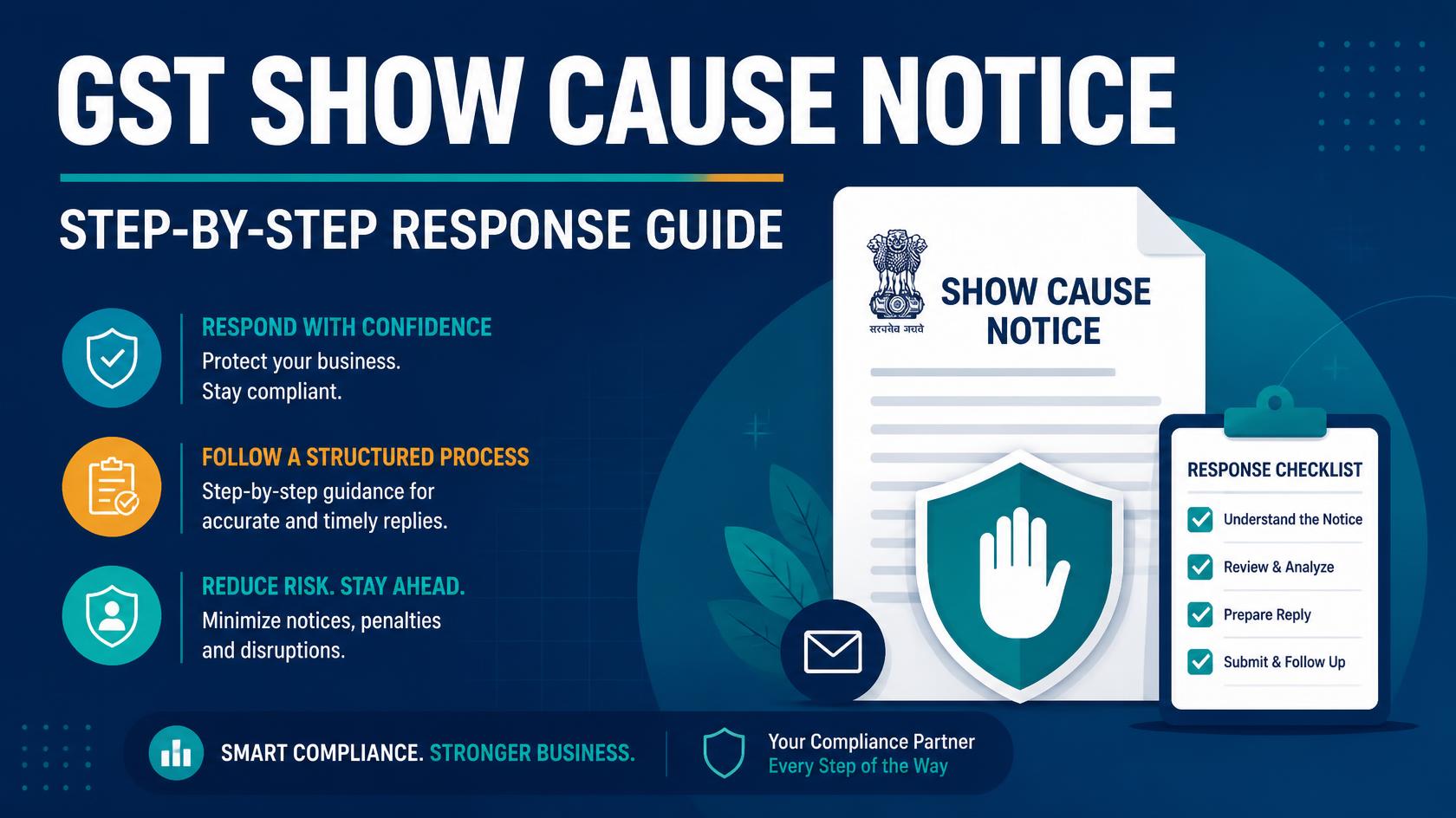
How to Respond to a GST Show Cause Notice (SCN): Step-by-Step
A GST Show Cause Notice — issued in Form DRC-01 — is the point where a routine compliance discrepancy becomes a formal legal proceeding. Unlike earlier-stage notices such as ASMT-10 or DRC-01A, a DRC-01 requires a structured, evidence-backed reply within a fixed deadline, and how well that reply is drafted has a direct bearing on whether the demand gets dropped, reduced, or confirmed.
This guide walks through the complete response process — from reading the notice correctly to filing an appeal if needed — with the exact forms, deadlines, and documentation required at each stage.
What Is a GST Show Cause Notice (DRC-01)?
Form GST DRC-01 is issued when the proper officer has reason to believe that tax has been unpaid, short-paid, or that Input Tax Credit has been wrongly availed or utilized. It formally initiates adjudication proceedings and is issued under one of the following legal provisions:
Section 73 — for cases not involving fraud, willful misstatement, or suppression of facts (genuine errors, omissions, interpretation disputes)
Section 74 — for cases involving fraud, willful misstatement, or suppression of facts (carries significantly higher penalty exposure)
Section 74A — a consolidated provision applicable from FY 2024–25 onwards, replacing the need to separately invoke 73 or 74 for periods it covers
The section under which the notice is issued matters enormously — it determines the applicable penalty rate and the legal standard the department needs to meet.
The Complete SCN Response Process: Step-by-Step
Step 1: Read the Notice Carefully and Verify the Basics
Before drafting any substantive reply, confirm:
The notice reference number and whether it was served through the correct channel
The specific tax period(s) covered
Which section has been invoked (73, 74, or 74A) — and whether the facts actually support that section
Whether a pre-SCN intimation (DRC-01A) was issued beforehand, where required under Section 73(5)/(6) — if it wasn't, this can be raised as a procedural objection
Whether the notice is time-barred under the statutory limitation period for the relevant section
Step 2: Gather Supporting Documents
Collect everything relevant to the allegations: GST returns (GSTR-1, GSTR-3B, GSTR-2B/2A), purchase and sales registers, invoices, e-way bills, contracts, bank statements, and any prior correspondence with the department on the same issue.
Step 3: Reconcile Returns Against Books
Compare GSTR-1, GSTR-3B, and GSTR-2B/2A data against your books of accounts to independently verify whether the discrepancy the department has flagged is accurate, partially accurate, or incorrect. This reconciliation becomes the evidentiary backbone of your reply.
Step 4: Draft a Structured, Point-Wise Reply
Address every specific allegation individually — vague, general denials are far less effective than a specific, figure-backed rebuttal for each point raised in the notice. Where the department's figures are simply wrong, show the correct calculation. Where you disagree with the legal interpretation, state the basis clearly.
Step 5: Decide on Voluntary Payment (Full, Partial, or None)
You have three practical options at this stage:
Pay in full via Form DRC-03 to close the matter, generally securing the lowest penalty exposure
Pay partially for the portion you agree with, while contesting the rest in your DRC-06 reply
Contest the entire demand if you believe none of it is valid, backed by full documentation
Step 6: File the Reply in Form DRC-06
Submit your detailed reply through the GST portal (under "View Additional Notices/Orders"), attaching all supporting documents and reconciliation workings, within the deadline specified in the notice — typically 30 days from the date of service.
Step 7: Request or Attend a Personal Hearing
A personal hearing may be granted on request or offered by the officer directly — this is a taxpayer's right under Section 75(4). Attend with complete documentation and a written synopsis of your arguments; this is an opportunity to reinforce your written reply, not replace it.
Step 8: Track the Adjudication Order (DRC-07)
After reviewing your reply and hearing, the officer passes a final order in Form DRC-07 — confirming the demand in full, reducing it, or dropping the proceedings entirely.
Step 9: Appeal If Necessary (Form APL-01)
If you disagree with the DRC-07 order, you can appeal to the Appellate Authority using Form APL-01, within 3 months of the order, along with a 10% pre-deposit of the disputed tax amount.
Visual Flow: How a GST Show Cause Notice Progresses
 [DRC-01A: Pre-SCN Intimation — optional voluntary settlement]
                        │
                        ▼
        [DRC-01: Formal Show Cause Notice Issued]
                        │
          ┌─────────────┴─────────────┐
          ▼                           ▼
  [Pay in full via DRC-03]   [Reply in Form DRC-06]
   (proceedings may close)    (within 30 days, with
                               evidence & reconciliation)
                        │
                        ▼
             [Personal Hearing, if granted]
                        │
                        ▼
              [Officer Passes Order: DRC-07]
                        │
          ┌─────────────┴─────────────┐
          ▼                           ▼
 [Demand Dropped/Reduced]     [Demand Confirmed]
        (Matter closed)               │
                                       ▼
                          [Appeal via APL-01 within
                           3 months + 10% pre-deposit]
Key Deadlines and Requirements at a Glance
Stage | Form | Deadline | Requirement |
|---|---|---|---|
Reply to Show Cause Notice | DRC-06 | 30 days from service (as specified in notice) | Point-wise response with evidence |
Voluntary payment (any stage) | DRC-03 | Before or during proceedings | Reduces or eliminates penalty depending on timing |
Personal hearing | — | Granted on request or suo motu | Right under Section 75(4) |
Adjudication order | DRC-07 | Issued after reply/hearing | Confirms, reduces, or drops demand |
Appeal against order | APL-01 | 3 months from DRC-07 order | 10% pre-deposit of disputed tax |
Penalty Exposure by Section
Section | Nature of Case | Penalty If Confirmed | Penalty If Paid Voluntarily Before SCN |
|---|---|---|---|
Section 73 | Non-fraud (genuine error, omission) | Generally around 10% of tax, or ₹10,000, whichever is higher | Can be nil if paid with interest before notice is issued |
Section 74 | Fraud, willful misstatement, or suppression | Up to 100% of the tax amount | Reduced penalty (typically 15%) if paid before SCN; higher reductions available at earlier stages of payment |
Section 74A | Consolidated provision (FY 2024–25 onwards) | Varies based on facts, aligned with 73/74 principles | Similar voluntary-payment incentives apply |
The difference between Section 73 and Section 74 outcomes is significant enough that, if a Section 74 notice appears to lack any real basis for alleging fraud, challenging the invocation of that section itself is a valid and often effective part of the reply.
What Happens If You Miss the DRC-06 Deadline
Missing the 30-day window doesn't automatically mean the demand is confirmed, but it substantially weakens your position:
The officer can proceed to pass an order based solely on the material already available (an ex-parte order)
The demand is typically confirmed at the full amount, since your explanation was never considered
The reduced-penalty benefit tied to timely voluntary payment or response is lost
You're left relying entirely on the appeal process, which is a more difficult position than responding at the SCN stage
Common Mistakes That Weaken an SCN Reply
Filing a generic or vague reply instead of addressing each specific allegation with figures and evidence
Not verifying jurisdiction and procedural correctness — such as confirming the officer has proper jurisdiction, or that a required pre-SCN intimation (DRC-01A) was actually issued
Accepting the invoked section without question — if Section 74 (fraud) is invoked without any real evidence of fraud, this is a legitimate point to challenge
Skipping the personal hearing or attending unprepared, without a written synopsis to reinforce the DRC-06 reply
Waiting until close to the deadline to start reconciliation — a rushed reconciliation under time pressure is far more likely to contain errors that weaken the reply
Not requesting an adjournment when genuinely needed — adjournments are usually granted once, and a rushed hearing is rarely in the taxpayer's favor
Why Reconciliation Is the Real Foundation of a Strong Reply
Nearly every effective step in this process — verifying the department's figures, drafting a point-wise rebuttal, deciding what to pay voluntarily — depends on having an accurate, defensible reconciliation between your GST returns and your books. A reply built on a rushed or incomplete reconciliation is a reply built on a weak foundation, regardless of how well it's written. This is precisely why maintaining monthly reconciliation discipline year-round, rather than scrambling to build one after a notice arrives, makes the difference between a confident, evidence-backed DRC-06 reply and a defensive one.
Final Thoughts
A GST Show Cause Notice is serious, but it's not an automatic loss — it's a structured process with clear deadlines, a defined reply mechanism, and a right to be heard before any order is passed. The businesses that come out of this process well are almost always the ones that treat the DRC-06 reply as the primary defense it actually is, backed by a reconciliation they can stand behind, rather than a rushed response filed just to meet the deadline.
Written by Abhishek Madoliya
Tax VerifiedPublished by the TaxSolver editorial and compliance research group. All guidelines and tax calculations are reviewed against CBIC statutory notifications and CGST Act rules.
Frequently Asked Questions
Q:What is the deadline to respond to a GST Show Cause Notice?
Generally 30 days from the date of service of the DRC-01 notice, though the exact deadline is specified in the notice itself and should always be confirmed there.
Q:What form is used to reply to a DRC-01 notice?
The reply is filed in Form DRC-06 on the GST portal, under the "View Additional Notices/Orders" section, along with supporting documents and reconciliation workings.
Q:What happens if I don't respond to the Show Cause Notice at all?
The officer can pass an ex-parte order under Section 73(10) or 74(10) based on the material already available, typically confirming the full demand without your explanation being considered, and without the benefit of reduced penalty for voluntary compliance.
Q:What is the difference between Section 73 and Section 74 notices?
Section 73 applies to non-fraud cases such as genuine errors or omissions and carries lower penalty exposure. Section 74 applies to cases involving fraud, willful misstatement, or suppression of facts and can attract penalties of up to 100% of the tax amount.
Q:Can I pay only part of the demand and contest the rest?
Yes. You can pay the portion you agree with voluntarily through Form DRC-03 while contesting the remaining amount in your DRC-06 reply with supporting evidence.
Q:Am I entitled to a personal hearing before an order is passed?
Yes, under Section 75(4) of the CGST Act, the officer must grant a personal hearing if requested, or may offer one even without a request, before passing an adverse order.
Q:What happens after I file my DRC-06 reply?
The officer reviews the reply, may grant a personal hearing, and then passes a final order in Form DRC-07 — confirming the demand in full, reducing it, or dropping the proceedings.
Q:Can I appeal if I disagree with the final order?
Yes. An appeal can be filed in Form APL-01 to the Appellate Authority within 3 months of the DRC-07 order, along with a mandatory pre-deposit of 10% of the disputed tax amount.
Q:Does paying voluntarily before the SCN reduce my penalty?
Yes. Paying tax and interest voluntarily at the pre-SCN (DRC-01A) stage, or early in the SCN process, generally results in significantly lower penalty exposure compared to waiting for a confirmed demand order.
Q:Can a Show Cause Notice be challenged on procedural grounds alone?
Yes. If the notice is issued beyond the statutory limitation period, by an officer without proper jurisdiction, or without a required pre-SCN intimation where mandated, these procedural defects can be raised as preliminary objections independent of the merits of the underlying tax dispute.